
Table of Contents
Introduction
Have you ever wondered why the atomic mass on the periodic table is usually a decimal instead of a whole number?
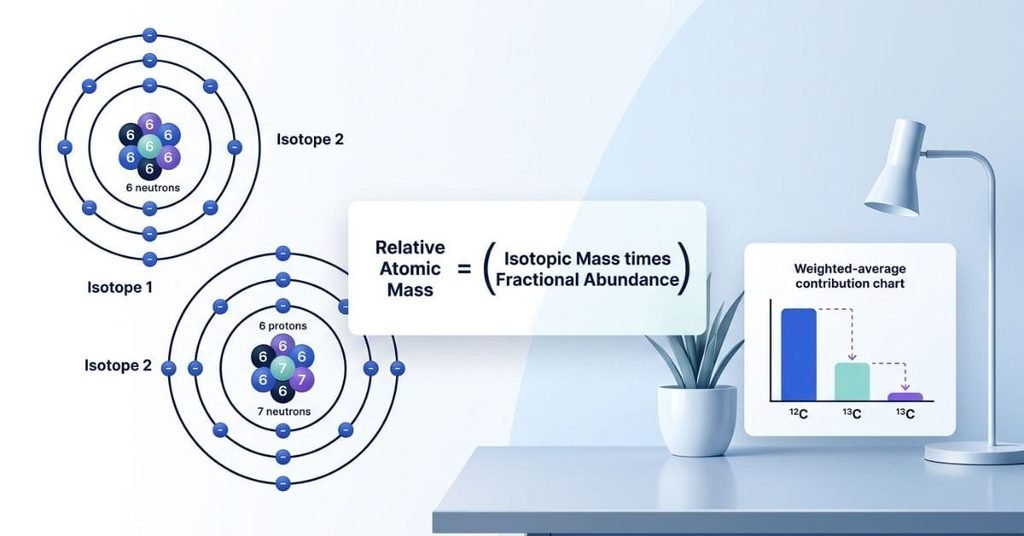
The answer lies in isotopes, which are atoms of the same element with different numbers of neutrons. Each isotope has its own mass and natural abundance. These differences affect the average atomic mass listed for every element.
Understanding how to calculate relative atomic mass of isotopes is an important chemistry skill for students. It helps you solve homework problems, prepare for chemistry exams, and understand the information on the periodic table. For beginners in the USA, learning this calculation also builds a strong foundation for more advanced chemistry topics.
The good news is that the process becomes simple once you understand the formula. In this guide, you will learn what relative atomic mass means and why isotope abundance matters. You will also discover the formula, follow a step-by-step calculation method, and explore worked examples with clear explanations.
By the end, you will know how to use isotope masses and relative abundances to calculate relative atomic mass confidently and accurately.
What Is Relative Atomic Mass?
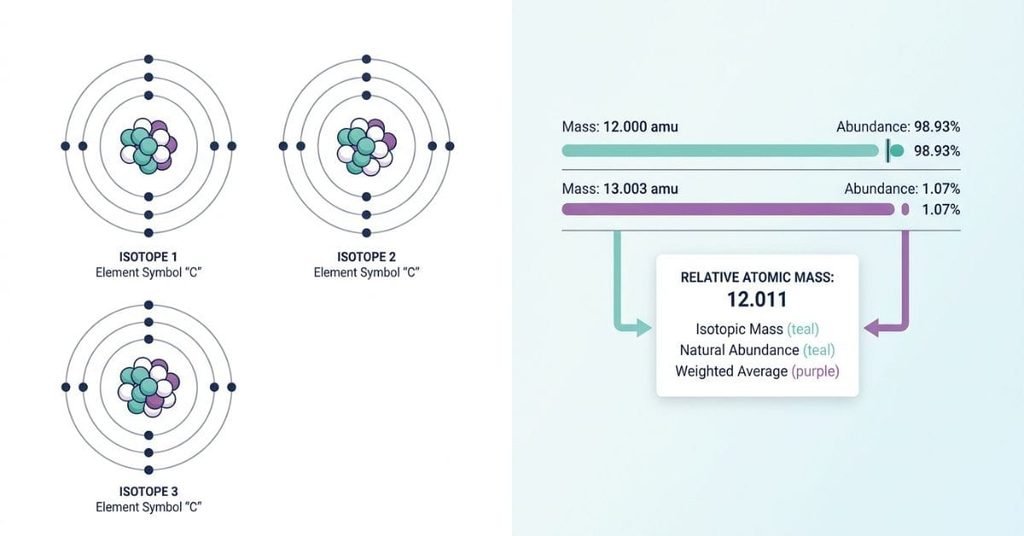
Relative atomic mass describes the average mass of an element’s atoms compared with one-twelfth of the mass of a carbon-12 atom. Scientists use it to represent the different masses of an element’s naturally occurring isotopes. You can usually find this value on the periodic table.
Isotopes of the same element have different masses because they contain different numbers of neutrons. However, not all isotopes occur in equal amounts in nature. Some are much more common than others, and this difference affects the element’s relative atomic mass.
Scientists calculate relative atomic mass using a weighted average. This means each isotope’s mass contributes according to its relative abundance. An isotope that occurs more often has a greater effect on the final result.
The answer often contains a decimal because it represents an average, not the mass of one specific atom. For example, chlorine has a relative atomic mass of approximately 35.45. This value reflects the combined contributions of its naturally occurring isotopes, mainly chlorine-35 and chlorine-37.
Why Do Elements Have Different Isotopes?
Atoms contain three main subatomic particles: protons, neutrons, and electrons. The number of protons determines which element an atom belongs to. For example, every carbon atom has six protons.
However, atoms of the same element can contain different numbers of neutrons. These variations create isotopes. Carbon-12 contains six neutrons, while carbon-14 contains eight neutrons. Both remain carbon because each has six protons.
Neutrons add mass to the nucleus, so isotopes with different neutron counts have different masses. Their chemical behavior remains broadly similar because they share the same number of protons and, in neutral atoms, electrons.
These mass differences help explain why relative atomic mass is not always a whole number. Scientists consider each naturally occurring isotope’s mass and abundance to calculate the weighted average. Understanding isotopes is the first step toward performing this calculation accurately.
What Is an Isotope?
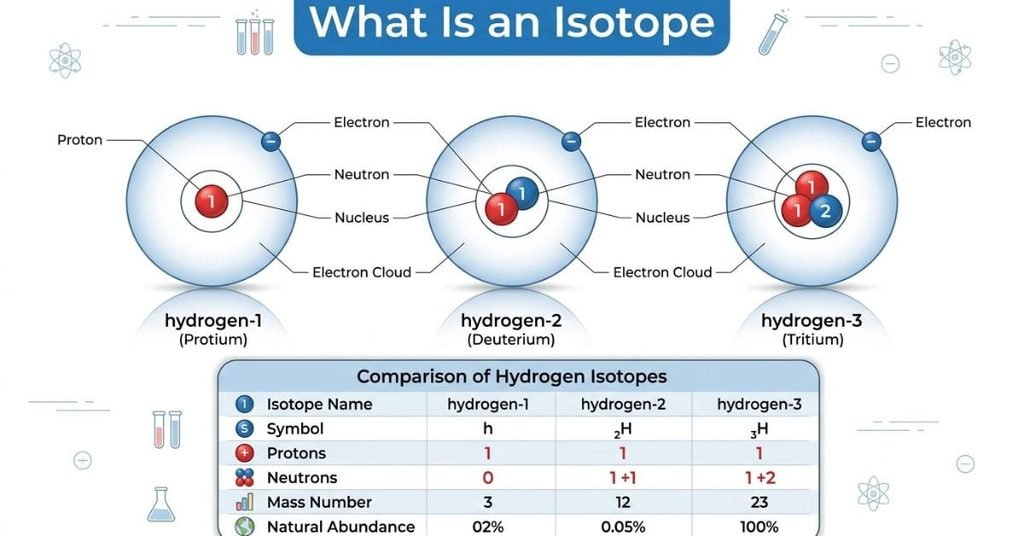
An isotope is a form of an element whose atoms contain the same number of protons but different numbers of neutrons. Since the number of protons identifies an element, all its isotopes belong to the same element. However, their different neutron counts give them different masses.
For example, carbon has several isotopes, including carbon-12, carbon-13, and carbon-14. Each contains six protons, but they contain six, seven, and eight neutrons, respectively. These differences affect their masses without changing the element’s identity.
Some isotopes are stable, while others are radioactive. Stable isotopes do not spontaneously decay through radioactive processes. Radioactive isotopes release radiation as their unstable nuclei change over time.
Isotopes also play an important role in calculating relative atomic mass. Elements often exist as mixtures of naturally occurring isotopes, and each isotope may have a different abundance. Scientists use these abundances and isotope masses to calculate the element’s weighted average mass.
Isotopes and Atomic Mass
Students often confuse isotope, isotopic mass, mass number, and relative atomic mass. Although these terms relate to atomic structure, each has a different meaning.
- Isotope: A form of an element with a specific number of protons and neutrons. For example, carbon-12 and carbon-14 are isotopes of carbon.
- Isotopic mass: The actual mass of a particular isotope, usually measured in unified atomic mass units (u). It can differ slightly from the isotope’s mass number.
- Mass number: The total number of protons and neutrons in an atom’s nucleus. Carbon-12 has a mass number of 12 because it contains six protons and six neutrons.
- Relative atomic mass: The weighted average mass of an element’s atoms compared with one-twelfth of the mass of a carbon-12 atom. It accounts for the masses and relative abundances of the element’s isotopes.
The key difference is that mass number counts particles, isotopic mass measures an individual isotope’s mass, and relative atomic mass represents a weighted average. Understanding these distinctions makes isotope calculations much easier.
Relative Atomic Mass Formula
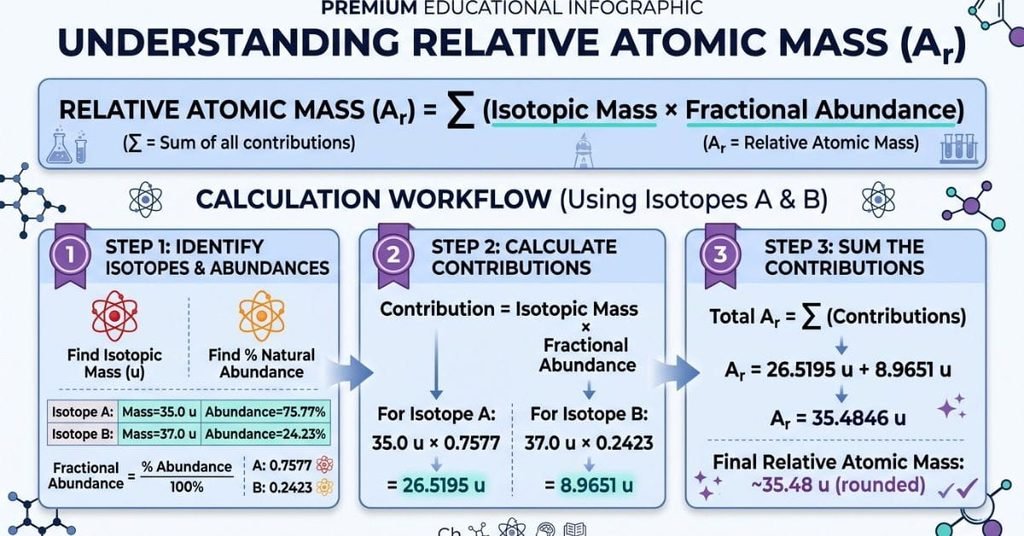
To calculate relative atomic mass, you need two pieces of information: each isotope’s mass and its relative abundance. The formula combines these values to find the weighted average mass of an element’s atoms.
Relative atomic mass = Σ (isotopic mass × relative abundance)
The symbol Σ (sigma) means you must add the contributions from all the isotopes being considered. Multiply each isotope’s mass by its abundance, then add the results together. This method gives more weight to isotopes that occur more frequently in the sample.
Here are the key terms you need to understand:
- Isotopic mass: The mass of an individual isotope, usually expressed in unified atomic mass units (u). For example, chlorine-35 has an isotopic mass of approximately 34.97 u.
- Relative abundance: The proportion of an isotope present in a sample or naturally occurring mixture. Scientists often express this value as a percentage.
- Weighting factor: The abundance determines how much each isotope contributes to the final average. A more abundant isotope has a greater influence than a less abundant isotope.
You can use either percentage abundance or decimal abundance in the calculation. However, you must use the correct form consistently.
When using decimal abundance, multiply each isotopic mass by its decimal fraction. When using percentage abundance, divide each percentage by 100 before multiplying, or divide the final weighted sum by 100.
How to Convert Isotope Abundance From Percent to Decimal
Converting percentage abundance into decimal form is simple. Divide the percentage by 100 by moving the decimal point two places to the left.
For example:
- 75% = 75 ÷ 100 = 0.75
- 20% = 20 ÷ 100 = 0.20
- 5% = 5 ÷ 100 = 0.05
Suppose an element has two isotopes with abundances of 75% and 25%. Their decimal abundances are 0.75 and 0.25. Together, they equal 1.00, representing the entire mixture.
Important: The abundances of all isotopes included in a complete mixture should add up to 100%, or 1.00 in decimal form. If they do not, check for missing isotopes, rounding differences, or inconsistent data. For a calculation involving only part of a mixture, make sure you understand whether the abundances need to be normalized before calculating the average.
How to Calculate Relative Atomic Mass of Isotopes
Learning how to calculate relative atomic mass of isotopes becomes easier when you follow a clear, repeatable method. You need the mass of each isotope and its relative abundance. Then, multiply each mass by its abundance and add the results.
Let’s use a simple example throughout the steps. Imagine an element has two isotopes:
| Isotope | Isotopic mass | Relative abundance |
|---|---|---|
| Isotope A | 10 u | 75% |
| Isotope B | 11 u | 25% |
These values are hypothetical and help demonstrate the calculation method.
Step 1 — Identify the Isotopes
Start by identifying every isotope listed in the chemistry problem. Most questions provide the isotope names, their masses, and their relative abundances. Some questions may give mass numbers instead of isotopic masses.
In our example, the element has two isotopes: Isotope A and Isotope B. Record the information in a table to keep the values organized and avoid mixing them up.
Step 2 — Find the Mass of Each Isotope
Next, identify the mass of each isotope. Chemistry problems may provide isotopic masses directly, often in unified atomic mass units (u). These values can include decimals because they represent measured atomic masses.
Do not confuse isotopic mass with mass number. The mass number counts the protons and neutrons in an atom’s nucleus. Isotopic mass represents the isotope’s actual mass and usually differs slightly from its mass number.
For this example, Isotope A has a mass of 10 u, while Isotope B has a mass of 11 u.
Step 3 — Find the Relative Abundance
Relative abundance tells you how much of each isotope exists in the mixture. Questions usually express this information as a percentage.
In our example, Isotope A makes up 75% of the mixture, while Isotope B makes up 25%. Their abundances total 100%, so they represent the complete mixture.
Step 4 — Convert Abundance to Decimal Form
Convert each percentage into a decimal by dividing it by 100. This makes the values suitable for the weighted-average formula.
- Isotope A: 75% ÷ 100 = 0.75
- Isotope B: 25% ÷ 100 = 0.25
Check that the decimal abundances add up to 1.00 when they represent the complete mixture.
Step 5 — Multiply Each Isotope Mass by Its Abundance
Multiply each isotope’s mass by its decimal abundance. This calculates how much each isotope contributes to the final average.
Isotope A:
10 × 0.75 = 7.50
Isotope B:
11 × 0.25 = 2.75
Isotope A contributes more because it has the higher abundance. These products are the weighted values you will add in the next step.
Step 6 — Add the Weighted Values
Add the weighted values from all the isotopes to calculate the relative atomic mass.
Relative atomic mass = 7.50 + 2.75
Relative atomic mass = 10.25
Therefore, the relative atomic mass of this hypothetical element is 10.25. The result is a weighted average based on the masses and abundances of both isotopes.
Step 7 — Check Your Answer
Finally, check whether your answer makes sense. A weighted average should fall between the lowest and highest isotope masses when all abundances are positive and total 100%.
Our answer, 10.25, falls between 10 u and 11 u. It is also closer to 10 u because Isotope A is more abundant.
If your answer falls outside this range, check your decimal conversions, multiplication, and addition. Also, confirm that you included every isotope and used consistent abundance values. Keep enough decimal places during your calculations, then round the final answer as the question requires.
Worked Example of Relative Atomic Mass
Let’s calculate the relative atomic mass of an element with two isotopes. This example uses simple numbers to help you understand each step without getting lost in complex calculations.
Suppose an element contains the following isotopes:
| Isotope | Isotopic mass | Abundance |
|---|---|---|
| Isotope A | 10 u | 20% |
| Isotope B | 11 u | 80% |
Follow these four steps to find the relative atomic mass.
Step 1: Convert Percentages to Decimals
Divide each percentage by 100 to convert it into decimal form.
- Isotope A: 20 ÷ 100 = 0.20
- Isotope B: 80 ÷ 100 = 0.80
Check your conversion: 0.20 + 0.80 = 1.00. Both isotopes account for the entire mixture.
Step 2: Multiply Each Mass by Its Abundance
Multiply each isotope’s mass by its decimal abundance to calculate its weighted contribution.
For Isotope A:
10 × 0.20 = 2.00
For Isotope B:
11 × 0.80 = 8.80
Isotope B contributes more to the average because it makes up 80% of the mixture.
Step 3: Add the Weighted Values
Now, add both contributions together.
Relative atomic mass = 2.00 + 8.80
Relative atomic mass = 10.80
Step 4: State the Final Answer
The relative atomic mass of this element is 10.8.
This result falls between the two isotope masses, 10 and 11. It lies closer to 11 because Isotope B has the greater abundance.
Remember: Convert percentages to decimals, multiply each isotope’s mass by its abundance, and add the weighted values. This method works for elements with two isotopes or many isotopes.
How to Calculate Relative Atomic Mass From Isotopes
To calculate atomic mass from isotopes, you need the mass of each isotope and its relative abundance. The method works for elements with two isotopes, three isotopes, or even more. Multiply each isotopic mass by its decimal abundance, then add the results.
A realistic example is chlorine, which occurs naturally mainly as chlorine-35 and chlorine-37. Chlorine-35 has an isotopic mass of approximately 34.969 u and an abundance of about 75.8%. Chlorine-37 has an isotopic mass of approximately 36.966 u and an abundance of about 24.2%.
Example With Two Isotopes
Use the chlorine data to calculate its relative atomic mass.
| Isotope | Isotopic mass (u) | Abundance | Decimal abundance |
|---|---|---|---|
| Chlorine-35 | 34.969 | 75.8% | 0.758 |
| Chlorine-37 | 36.966 | 24.2% | 0.242 |
Step 1: Multiply each mass by its decimal abundance.
- Chlorine-35: 34.969 × 0.758 = 26.5065
- Chlorine-37: 36.966 × 0.242 = 8.9498
Step 2: Add the weighted contributions.
Relative atomic mass = 26.5065 + 8.9498
Relative atomic mass ≈ 35.46
The result is close to the value shown for chlorine on many periodic tables. Small differences can occur because isotope masses and abundances are rounded.
Example With Three Isotopes
The same formula works when an element has three isotopes. Consider a hypothetical element with the following data.
| Isotope | Isotopic mass (u) | Abundance | Decimal abundance |
|---|---|---|---|
| Isotope A | 10.0 | 20% | 0.20 |
| Isotope B | 11.0 | 30% | 0.30 |
| Isotope C | 12.0 | 50% | 0.50 |
Step 1: Multiply each mass by its abundance.
- Isotope A: 10.0 × 0.20 = 2.00
- Isotope B: 11.0 × 0.30 = 3.30
- Isotope C: 12.0 × 0.50 = 6.00
Step 2: Add all three contributions.
Relative atomic mass = 2.00 + 3.30 + 6.00
Relative atomic mass = 11.30
The answer is 11.30 because each isotope contributes according to its abundance. Notice that the most abundant isotope, Isotope C, has the greatest influence on the final average.
How to Calculate Atomic Mass of an Isotope
The phrase “calculate atomic mass of an isotope” can refer to different calculations. Before solving a problem, identify whether it asks for the mass number, the actual isotopic mass, or the relative atomic mass of an element.
These quantities are related, but they do not mean the same thing.
1. Mass number = protons + neutrons
The mass number is a whole number that counts the protons and neutrons in an atom’s nucleus. For example, a carbon-14 atom has six protons and eight neutrons.
Mass number = 6 + 8 = 14
You can calculate the mass number from the number of protons and neutrons. However, this calculation does not give the exact isotopic mass.
2. Isotopic mass = measured mass of a specific isotope
Isotopic mass describes the actual mass of an individual isotope, usually expressed in unified atomic mass units (u). For example, carbon-12 has an isotopic mass defined as exactly 12 u. Carbon-14 has an isotopic mass of approximately 14.0032 u.
Isotopic masses can differ from their mass numbers because nuclear binding energy affects the mass of the nucleus. Therefore, adding the proton and neutron counts gives the mass number, not the exact isotopic mass. To obtain a precise isotopic mass, use reliable reference data or measurements.
3. Relative atomic mass = weighted average of isotopic masses
Relative atomic mass describes the average mass of an element’s atoms compared with one-twelfth of the mass of a carbon-12 atom. It accounts for the isotopic masses and their relative abundances.
Use this formula:
For example, chlorine’s relative atomic mass is approximately 35.45 because its naturally occurring isotopes contribute different amounts to the average.
The key takeaway: Add protons and neutrons to find the mass number. Use measured data for an isotope’s actual mass. Use isotopic masses and abundances to calculate an element’s relative atomic mass.
Relative Isotopic Mass vs Relative Atomic Mass
Relative isotopic mass and relative atomic mass are related terms, but they describe different measurements. Understanding the difference helps you choose the correct value when learning how to calculate relative isotopic mass.
Relative Isotopic Mass
Relative isotopic mass is the mass of one specific isotope compared with one-twelfth of the mass of a carbon-12 atom. It has no unit because it compares two masses.
For example, carbon-12 has a relative isotopic mass of exactly 12. Carbon-14 has a relative isotopic mass of approximately 14.0032. These values describe individual isotopes, not an average of all isotopes.
Use relative isotopic mass when you need the mass of a particular isotope for a calculation or scientific comparison.
Relative Atomic Mass
Relative atomic mass is the weighted average of an element’s isotopic masses, based on their natural abundances. It considers both the mass of each isotope and how common that isotope is.
For example, chlorine has two main naturally occurring isotopes: chlorine-35 and chlorine-37. Chlorine-35 is more abundant, so it contributes more to the average. This gives chlorine a relative atomic mass of approximately 35.45.
Use relative atomic mass when you need the average value shown on most periodic tables. To calculate it, multiply each isotopic mass by its fractional abundance, then add the results.
Key takeaway: Relative isotopic mass describes one isotope. Relative atomic mass represents the abundance-weighted average of an element’s isotopes.
Atomic Mass vs Mass Number
Atomic mass and mass number may seem similar, but they represent different properties of an atom. Knowing the difference helps you avoid mistakes when working with isotope calculations.
Atomic Mass
In periodic-table questions, students often use atomic mass to mean the decimal value listed below an element’s symbol. This value usually represents the element’s relative atomic mass, expressed approximately in atomic mass units (u) when discussing average mass.
For example, chlorine has an average atomic mass of about 35.45 u. Its decimal value reflects the different masses and natural abundances of its isotopes.
Mass Number
Mass number is the total number of protons and neutrons in one atom’s nucleus. Unlike atomic mass, it is always a whole number.
Use this formula:
For example, carbon-14 contains 6 protons and 8 neutrons. Its mass number is \(6+8=14\).
Why They Are Not the Same
Atomic mass and mass number differ because they describe different things. Mass number counts particles in one nucleus, while atomic mass measures mass. The mass of a particular isotope is usually close to its mass number in atomic mass units, but it is not exactly the same.
Consider carbon-14. Its mass number is exactly 14 because it contains 6 protons and 8 neutrons. However, its measured isotopic mass is approximately 14.0032 u.
Carbon’s periodic-table atomic mass is about 12.011 u because it reflects the natural abundances of carbon-12 and carbon-13, rather than carbon-14 alone.
Remember: Use mass number to count protons and neutrons. Use isotopic mass for the measured mass of a specific isotope, and relative atomic mass for an element’s abundance-weighted average.
Common Mistakes When Calculating Relative Atomic Mass
When learning how to calculate relative atomic mass, students often make small errors that change the final answer. Use these common mistakes to check your working and improve your accuracy.
1. Adding Isotope Masses Without Considering Abundance
Each isotope contributes according to its natural abundance. Do not simply add the isotope masses and divide by their number.
For example, an isotope with 90% abundance affects the average more than one with 10% abundance. Multiply each isotope’s mass by its fractional abundance before adding the contributions.
2. Forgetting to Convert Percentages to Decimals
The formula requires fractional abundances, not percentages. Convert each percentage by dividing it by 100.
For example, 75% becomes 0.75, while 25% becomes 0.25. Using 75 instead of 0.75 makes the calculation incorrect.
3. Confusing Mass Number With Isotopic Mass
Mass number is the total number of protons and neutrons. Isotopic mass is the measured mass of a particular isotope, usually expressed in atomic mass units (u).
For example, carbon-14 has a mass number of 14, but its isotopic mass is approximately 14.0032 u. Use the value requested in the question.
4. Using the Wrong Abundance for an Isotope
Always match each abundance to its correct isotope. If an isotope has a mass of 20 u and an abundance of 80%, use those values together.
Switching the abundance values can produce a different weighted average, even when the masses are correct.
5. Rounding Too Early
Keep several decimal places during intermediate calculations. Round only the final answer to the required precision.
Early rounding can slightly change each weighted contribution and create a less accurate result.
6. Forgetting an Isotope in the Calculation
Include every isotope listed in the question. Check that all abundance percentages add up to 100%, allowing for small differences caused by rounding.
Leaving out an isotope can shift the final average away from the correct value.
7. Confusing Relative Atomic Mass With Molar Mass
Relative atomic mass is a ratio and has no unit. Molar mass describes the mass of one mole of a substance and is commonly expressed in grams per mole (g/mol).
For example, chlorine has a relative atomic mass of approximately 35.45. Its molar mass is approximately 35.45 g/mol. The numerical values are similar, but the quantities and units differ.
How to Check Your Relative Atomic Mass Answer
A quick check can help you catch mistakes before submitting your chemistry work. Follow these steps after completing your calculation.
1. Check isotope abundances. Add the percentages together. They should total 100%, or approximately 100% if the values are rounded.
2. Use abundances consistently. Convert every percentage to a decimal before multiplying. For example, 40% becomes 0.40. Do not mix percentages and decimals in the same calculation.
3. Check each multiplication. Multiply every isotope’s mass by its matching fractional abundance. Then add all the weighted contributions together.
4. Check whether the answer is sensible. The weighted average should fall between the smallest and largest isotope masses included. It should also be closer to the masses of the more abundant isotopes.
5. Avoid excessive rounding. Keep extra decimal places until the final step. Then round according to the question’s instructions.
Quick example: Suppose two isotopes have masses of 10 u and 12 u, with abundances of 25% and 75%.
The answer is 11.5. It lies between 10 and 12 and is closer to 12, which has the higher abundance.
Relative Atomic Mass Example With Real Isotopes
Chlorine provides a useful real-world example because it has two main naturally occurring isotopes. These isotopes have different masses and different natural abundances, so their weighted average is not a whole number.
Step 1: Identify the Isotopes
Natural chlorine mainly contains chlorine-35 and chlorine-37. For this calculation, use their approximate isotopic masses and natural abundances.
| Isotope | Isotopic mass (u) | Abundance |
|---|---|---|
| Chlorine-35 | 34.969 | 75.8% |
| Chlorine-37 | 36.966 | 24.2% |
The abundance percentages total 100%, so the values are suitable for a weighted-average calculation.
Step 2: Convert Abundances to Decimals
Divide each percentage by 100.
These decimal values represent the fraction of each isotope in natural chlorine.
Step 3: Calculate Each Weighted Contribution
Multiply each isotopic mass by its decimal abundance.
| Isotope | Calculation | Contribution |
|---|---|---|
| Chlorine-35 | \(34.969\times0.758\) | 26.5065 |
| Chlorine-37 | \(36.966\times0.242\) | 8.9498 |
Each contribution shows how much that isotope adds to the overall average.
Step 4: Add the Contributions
Now add both weighted contributions:
Therefore, the relative atomic mass is approximately 35.46 when rounded to two decimal places.
This result lies between the two isotopic masses. It is closer to chlorine-35 because that isotope has the greater natural abundance.
Pro tip: Use the isotopic masses and abundances provided in your question whenever possible. Published values may vary slightly because of rounding, so your final answer may differ by a small amount.
Conclusion
Understanding how to calculate relative atomic mass of isotopes becomes easier with practice. This guide explained the formula, isotope abundances, worked examples, and common calculation mistakes. You also learned how relative isotopic mass differs from relative atomic mass and mass number.
The key is to multiply each isotope’s mass by its fractional abundance, then add the results. Always check your abundances and avoid rounding too early. These simple steps can help you solve chemistry problems with greater confidence.
Ready to test your understanding? Try calculating the relative atomic mass of another element using its isotopic data. Share your questions or learning tips in the comments. Explore more chemistry guides on our website to strengthen your skills and prepare for your next exam.
Frequently Asked Questions
Find clear answers to common questions about isotope masses and relative atomic mass.
How do you calculate relative atomic mass of isotopes?
Multiply each isotope’s mass by its fractional abundance. Then add all the weighted contributions together. Convert percentage abundances into decimals before calculating. For example, 75% becomes 0.75. Your final answer is the relative atomic mass, which reflects the natural abundance of each isotope.
How do you calculate relative isotopic mass?
Relative isotopic mass compares the mass of a specific isotope with one-twelfth of the mass of a carbon-12 atom. It is usually obtained from measured isotopic mass data. Unlike relative atomic mass, it describes one isotope rather than an abundance-weighted average of an element’s isotopes.
How do you calculate atomic mass from isotopes?
To calculate an element’s average atomic mass, multiply each isotope’s mass by its fractional abundance. Add these values to find the weighted average.
For example, if two isotopes have masses of 10 u and 12 u, with abundances of 25% and 75%, the average is 11.5 u.
How do you calculate atomic mass of an isotope?
Use the measured isotopic mass provided in your chemistry question or a reliable reference table. You cannot find the exact isotopic mass by simply adding protons and neutrons. That calculation gives the mass number, which is a whole number. The measured isotopic mass may differ slightly.
How do you calculate atomic mass of isotopes?
First, identify every isotope and its isotopic mass. Next, convert each abundance percentage into a decimal. Multiply each mass by its matching abundance, then add the results. Include all the listed isotopes and keep extra decimal places until your final answer.
What is the formula for relative atomic mass?
The formula for relative atomic mass is:
Relative atomic mass = Σ (isotopic mass × fractional abundance)Multiply each isotope’s mass by its fractional abundance, then add the contributions. If abundances are given as percentages, divide each percentage by 100 before using the formula.
Why is relative atomic mass usually a decimal?
Relative atomic mass is usually a decimal because it represents a weighted average of an element’s naturally occurring isotopes. These isotopes have different masses and abundances. For example, chlorine’s relative atomic mass is approximately 35.45 because its natural isotopes contribute different amounts to the average.
What is the difference between relative atomic mass and mass number?
Mass number is the total number of protons and neutrons in one atom’s nucleus. It is always a whole number. Relative atomic mass is the weighted average of an element’s isotopic masses, based on their natural abundances. It is usually a decimal and has no unit.
Do isotope abundances have to add up to 100%?
Yes, the natural abundances of all isotopes of an element should add up to 100%. Small differences may occur because published values are rounded. If the total differs significantly from 100%, check that you included every isotope and copied the abundance values correctly.

We are the Chemistry Study Tools Team, focused on creating simple and practical tools that help students with chemistry and academic calculations. Our platform is designed for high school and college students who want an easier way to work through chemistry problems, grades, and GPA calculations.
We create student-friendly calculators and learning resources covering topics such as atomic structure, moles, molar mass, stoichiometry, chemical equations, solutions, concentration, acids, bases, pH, grades, and GPA.
Through ChemistryStudyTools.com, our goal is to provide useful resources that help students understand their calculations, check their work, and study more effectively.