
Table of Contents
Introduction
What if one element has several isotope masses but only one atomic mass on the periodic table?
Learning how to calculate relative atomic mass helps you understand why isotope values combine into one useful number. This topic often appears in high school chemistry, AP Chemistry, and introductory college courses in the USA.
Relative atomic mass accounts for both isotope masses and their natural abundances. You cannot simply take the average of all isotope masses. Each isotope must be weighted by how common it is.
In this guide, you will learn the relative atomic mass formula and how to use it correctly. We will break the calculation into simple steps that beginners can follow.
You will also see clear worked examples using realistic isotope data. By the end, you will know how to calculate relative atomic mass with confidence. You will also understand how isotope abundance affects the final result.
What Is Relative Atomic Mass?
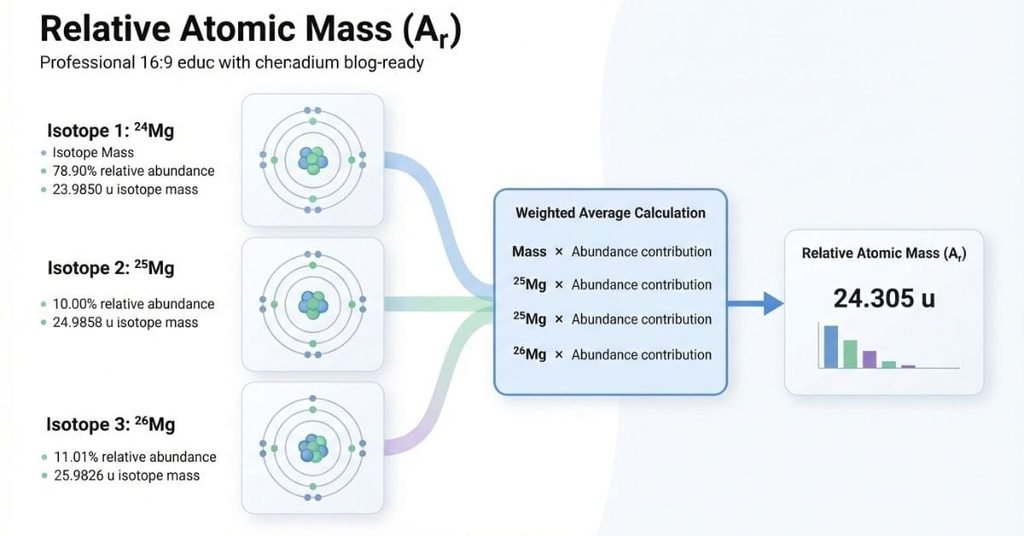
Relative atomic mass tells you the average mass of an element’s atoms compared with a standard atomic mass scale. It considers the different isotopes found naturally in a sample.
If you prefer a faster method, try the Relative Atomic Mass Calculator to calculate relative atomic mass from isotope data.
Most elements exist as mixtures of isotopes. Isotopes are atoms of the same element with the same number of protons. They have different numbers of neutrons, so their masses are different.
Select an Element
Choose an element to view its isotope information and atomic mass.
Carbon
Common Isotopes
Natural abundance tells you how common each isotope is in the sample. An isotope that occurs more often has a greater effect on the final relative atomic mass.
This is why the value can be a decimal. The calculation uses a weighted average rather than selecting one isotope or taking a simple average.
Why Is Relative Atomic Mass Usually a Decimal?
Consider chlorine, which naturally contains mainly chlorine-35 and chlorine-37. Chlorine-35 is more abundant, so it contributes more to the average.
Because the two isotopes have different masses and abundances, their weighted average falls between their individual masses. The periodic table therefore shows chlorine with a relative atomic mass close to 35.45, rather than a whole number.
Relative Atomic Mass Formula
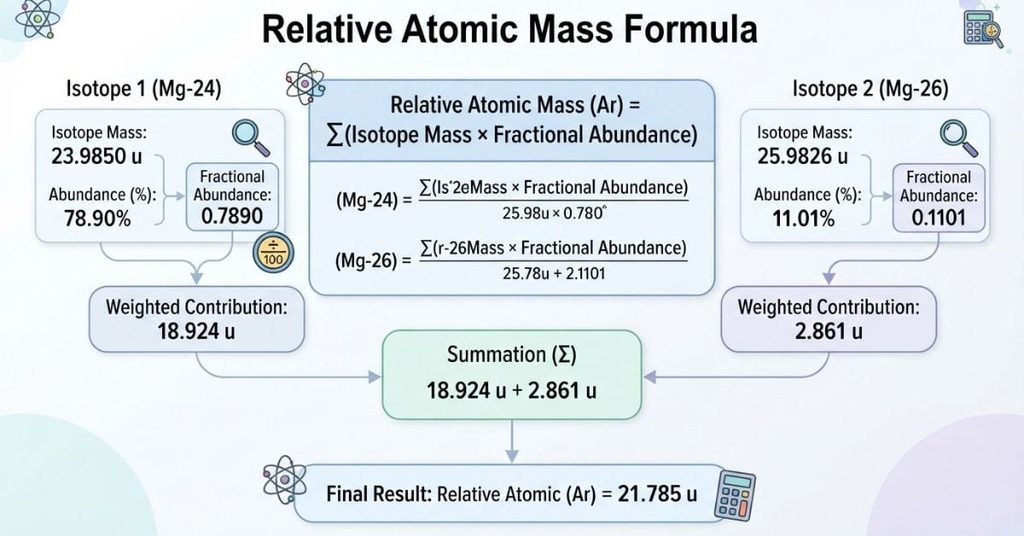
You can calculate relative atomic mass by multiplying each isotope’s mass by its relative abundance. Then, add the contributions from all isotopes.
Here, each part has a specific role:
- Isotope mass: The mass of a particular isotope.
- Relative abundance: The fraction of that isotope found naturally.
- Weighting factor: Abundance controls how strongly each isotope affects the average.
- Decimal abundance: Percentage abundance must be converted into decimal form before using this formula.
For example, an isotope found 75% of the time has more influence than one found 25% of the time. This weighting produces an average that reflects the actual isotope mixture.
Converting Percentage Abundance to Decimal
Convert percentage abundance by dividing the percentage by 100.
For example:
So, 75% becomes 0.75 in the formula.
The isotope abundances should represent the whole sample. When all isotope percentages are included, they should add up to 100%. Their decimal abundances should therefore add up to 1.00.
Pro Tip: Check the abundance total before calculating. An incorrect total can produce an incorrect relative atomic mass.
After solving the problem manually, use the Relative Atomic Mass Calculator to verify your final answer.
How to Calculate Relative Atomic Mass Step by Step
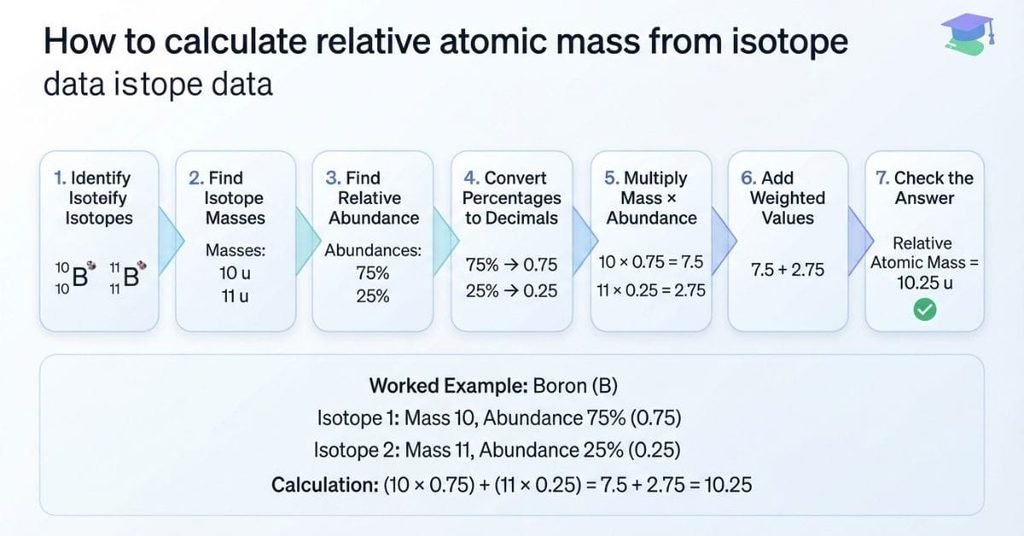
To calculate relative atomic mass, multiply each isotope mass by its abundance. Then add all the weighted values together.
This method works for questions that provide isotope masses and their percentage abundances. Follow each step carefully to avoid common calculation errors.
Step 1 — Identify the Isotopes
Start by listing every isotope given in the question. The question usually provides the isotope names, masses, and natural abundances.
For example, a sample might contain two isotopes. Write their information in separate rows before starting the calculation.
Step 2 — Find the Mass of Each Isotope
Use the isotope mass provided by the question. Don’t confuse isotope mass with mass number.
Mass number is the total number of protons and neutrons. Isotope mass is the measured mass of a specific isotope and may include decimal places.
Step 3 — Find the Relative Abundance
Next, identify the percentage abundance of each isotope. This tells you how common each isotope is in the sample.
For example, an isotope with 75% abundance makes up 75% of the natural sample. A less common isotope has a smaller effect on the final average.
Step 4 — Convert Percentages to Decimals
The formula uses decimal abundance rather than percentages. Divide each percentage by 100 to make the conversion.
For example:
Likewise, 25% becomes 0.25. Check that all decimal abundances add up to 1.00.
Step 5 — Multiply Each Isotope Mass by Its Abundance
Multiply each isotope’s mass by its decimal abundance. These products show how much each isotope contributes to the average.
For example, suppose two isotopes have masses of 10 and 11. Their abundances are 75% and 25%.
Step 6 — Add the Weighted Values
Now add the weighted contributions from all isotopes.
Therefore, the relative atomic mass is:
This result reflects both isotope masses and their relative abundances.
Step 7 — Check Your Answer
Your final value should normally fall between the lowest and highest isotope masses used.
Here, 10.25 falls between 10 and 11, so the result passes this basic check. If your answer falls outside that range, recheck your abundances and calculations.
Pro Tip: Keep several decimal places during your calculation. Round only at the final step unless the question gives different instructions.
How to Calculate Relative Atomic Mass Step by Step
To calculate relative atomic mass, multiply each isotope mass by its abundance. Then add all the weighted values together.
This method works for questions that provide isotope masses and their percentage abundances. Follow each step carefully to avoid common calculation errors.
Step 1 — Identify the Isotopes
Start by listing every isotope given in the question. The question usually provides the isotope names, masses, and natural abundances.
For example, a sample might contain two isotopes. Write their information in separate rows before starting the calculation.
Step 2 — Find the Mass of Each Isotope
Use the isotope mass provided by the question. Don’t confuse isotope mass with mass number.
Mass number is the total number of protons and neutrons. Isotope mass is the measured mass of a specific isotope and may include decimal places.
Step 3 — Find the Relative Abundance
Next, identify the percentage abundance of each isotope. This tells you how common each isotope is in the sample.
For example, an isotope with 75% abundance makes up 75% of the natural sample. A less common isotope has a smaller effect on the final average.
Step 4 — Convert Percentages to Decimals
The formula uses decimal abundance rather than percentages. Divide each percentage by 100 to make the conversion.
For example:
Likewise, 25% becomes 0.25. Check that all decimal abundances add up to 1.00.
Step 5 — Multiply Each Isotope Mass by Its Abundance
Multiply each isotope’s mass by its decimal abundance. These products show how much each isotope contributes to the average.
For example, suppose two isotopes have masses of 10 and 11. Their abundances are 75% and 25%.
Step 6 — Add the Weighted Values
Now add the weighted contributions from all isotopes.
Therefore, the relative atomic mass is:
This result reflects both isotope masses and their relative abundances.
Step 7 — Check Your Answer
Your final value should normally fall between the lowest and highest isotope masses used.
Here, 10.25 falls between 10 and 11, so the result passes this basic check. If your answer falls outside that range, recheck your abundances and calculations.
Pro Tip: Keep several decimal places during your calculation. Round only at the final step unless the question gives different instructions.
Worked Example of Relative Atomic Mass
Suppose an element has two naturally occurring isotopes. Their masses and abundances are given below.
- Isotope A: mass = 10, abundance = 20%
- Isotope B: mass = 11, abundance = 80%
First, convert each percentage into a decimal. Divide each percentage by 100.
Now multiply each isotope mass by its decimal abundance.
Finally, add the weighted values.
Therefore, the relative atomic mass is 10.80.
The result is closer to 11 because Isotope B has the higher abundance. This shows how abundance affects the final weighted average.
How to Calculate Relative Atomic Mass of Isotopes
Isotopes are atoms of the same element with the same number of protons. They have different numbers of neutrons, which gives them different masses.
Natural samples can contain several isotopes of the same element. Each isotope contributes to the element’s relative atomic mass based on its abundance.
A more abundant isotope has a greater effect on the final value. A less abundant isotope has a smaller effect.
To calculate the result, use a weighted average:
Convert each percentage to a decimal first. Then multiply each isotope mass by its abundance and add the results.
Relative Atomic Mass From Two Isotopes
Consider an element with two isotopes:
- Isotope A: mass = 20, abundance = 30%
- Isotope B: mass = 22, abundance = 70%
Convert the percentages:
Multiply each mass by its abundance:
Add the weighted values:
Therefore, the relative atomic mass is 21.40. It falls between the two isotope masses, as expected.
Relative Atomic Mass From Three Isotopes
The same method works when an element has three isotopes. Suppose their data are:
- Isotope A: mass = 24, abundance = 50%
- Isotope B: mass = 25, abundance = 30%
- Isotope C: mass = 26, abundance = 20%
Convert the abundances:
Now calculate each contribution:
Add the contributions:
Therefore, the relative atomic mass is 24.70. The same weighted-average process works for any number of isotopes.
Relative Atomic Mass vs Atomic Mass
Students often see terms like relative atomic mass, atomic mass, isotopic mass, and mass number. These terms relate to the mass of atoms, but they do not mean the same thing. Knowing the difference helps you use the correct value in chemistry calculations.
Relative Atomic Mass
Relative atomic mass is the weighted average mass of an element’s naturally occurring isotopes. It considers both isotope masses and their relative abundances. It has no unit because it compares atomic masses with a reference standard.
Isotopic Mass
Isotopic mass refers to the mass of one specific isotope. It is usually measured in unified atomic mass units (u). The isotopic mass can include the effects of nuclear binding and electron masses, so it does not always equal the isotope’s mass number.
Mass Number
Mass number is the total number of protons and neutrons in one atom’s nucleus. It is always a whole number and identifies a specific isotope.
For example, carbon-12 has 6 protons and 6 neutrons, giving it a mass number of 12.
Atomic Mass
Atomic mass can refer to the mass of an individual atom, usually expressed in u. In some chemistry contexts, “atomic mass” also refers to the average atomic mass shown on the periodic table. Because terminology can vary by textbook, check how your course defines the term.
The key distinction is simple: mass number counts particles, isotopic mass measures one isotope’s mass, and relative atomic mass gives a weighted isotopic average.
Need a quick calculation? Enter your isotope masses and abundances into our Relative Atomic Mass Calculator for an instant result
Common Mistakes When Calculating Relative Atomic Mass
Calculating relative atomic mass looks simple, but small errors can change the final answer. Most mistakes happen when students use isotope data incorrectly or mix up related chemistry terms.
Forgetting to Convert Percentages to Decimals
A percentage must become a decimal before you multiply it by isotope mass.
For example, 75% becomes 0.75, not 75. Using 75 directly makes the final answer far too large.
Adding Isotope Masses Directly
You cannot simply add isotope masses and divide by the number of isotopes. More abundant isotopes must have a greater effect on the average.
Confusing Mass Number With Isotope Mass
Mass number counts protons and neutrons, so it is a whole number. Isotopic mass represents the measured mass of a specific isotope and can have decimal values.
Ignoring Isotope Abundance
Each isotope contributes according to its abundance. Always multiply each isotope mass by its abundance before adding the contributions.
Using Incorrect Abundance Values
Check that you use the correct abundance for each isotope. Also make sure percentage abundances add to 100% when they represent the complete isotope set.
Rounding Too Early
Keep several decimal places during your calculations. Round the final relative atomic mass only after adding all isotope contributions.
Confusing Relative Atomic Mass With Molar Mass
Relative atomic mass is a dimensionless quantity. Molar mass describes the mass of one mole of a substance and uses units such as g/mol. They often have numerically similar values, but they represent different quantities.
A reliable process is: convert abundances, multiply, add, then round.
How to Check Your Relative Atomic Mass Answer
Checking your answer can help you catch calculation mistakes before submitting your work. A few simple checks can quickly show whether your relative atomic mass makes sense.
First, check the isotope abundances. They should represent proportions of the sample. If you have percentage abundances for all isotopes, they should normally add to 100%.
Next, check the weighted average. Your relative atomic mass should generally fall between the isotope masses you used. It should also be closer to the mass of the isotope with the greater abundance.
Then, check your percentage conversions. For example, 25% should become 0.25, while 80% should become 0.80.
If your answer seems unreasonable, go back through the calculation using the original values. Recalculate each multiplication before adding the weighted contributions.
These checks don’t replace the formula, but they provide a useful way to verify your work. They can help you find errors before you move on to the next chemistry problem.
Use a Relative Atomic Mass Calculator
You can also use a Relative Atomic Mass Calculator to check your calculations. It provides a quick way to work with isotope masses and relative abundances without repeating every step manually.
Enter the mass of each isotope and its relative abundance. The calculator then uses these values to find the weighted average and gives you the calculated relative atomic mass.
This can be especially useful when your problem contains several isotopes or decimal values. You can also use it after solving a problem by hand to check whether your result matches the calculator.
If you’re practicing the manual method, try solving the problem first. Then use the calculator to verify your answer and identify any calculation errors.
You can use the Relative Atomic Mass Calculator when you need a quick calculation or a second check on your work.
Frequently Asked Questions
To calculate relative atomic mass, multiply each isotope mass by its fractional abundance. Add all the weighted values together. If abundance is given as a percentage, divide each percentage by 100 first.
Use the isotope masses and their relative abundances to find a weighted average. Convert percentage abundances into decimals, multiply each isotope mass by its abundance, then add the results.
The formula is:
When percentage abundance is used, multiply each isotope mass by its percentage, add the results, and divide the total by 100.
List each isotope’s mass and abundance first. Convert the abundances to fractions, then multiply each isotope mass by its fraction. Add these weighted contributions to find the relative atomic mass.
Convert each percentage to a decimal by dividing it by 100. Multiply each isotope mass by its decimal abundance. Finally, add all the weighted values together.
Relative atomic mass is usually a decimal because it represents a weighted average of different isotope masses. Isotopes occur in different proportions, so the average often falls between their individual masses.
Relative atomic mass is a weighted average based on an element’s isotopes. Mass number is the total number of protons and neutrons in one specific isotope. Mass number is always a whole number.
Yes. When the values represent all naturally occurring isotopes of an element, their percentage abundances should add to 100%. Small differences can occur because of rounding in published data.

We are the Chemistry Study Tools Team, focused on creating simple and practical tools that help students with chemistry and academic calculations. Our platform is designed for high school and college students who want an easier way to work through chemistry problems, grades, and GPA calculations.
We create student-friendly calculators and learning resources covering topics such as atomic structure, moles, molar mass, stoichiometry, chemical equations, solutions, concentration, acids, bases, pH, grades, and GPA.
Through ChemistryStudyTools.com, our goal is to provide useful resources that help students understand their calculations, check their work, and study more effectively.